Every campus placement season, placement cells invest months of preparation. Companies are invited. Drives are conducted. And then some recruiters quietly disappear.
A company visited your campus last year. The drive went reasonably well. You followed up. They said they would consider returning next season. This year they are not on your list. No explanation. No feedback. Just silence.
That silence is not bad luck. It is a signal. And most placement cells never figure out what it is actually saying.
The Campus Placement Problem Nobody Is Talking About
Most placement cells diagnose the problem as a relationship problem. Not enough follow-up. Not enough communication. Not enough effort to keep recruiters engaged between seasons. so they work harder. More calls. More emails. More coordinators chasing companies. And the results stay roughly the same.
Universities often assume recruiters drop out due to market conditions — when in reality, operational inefficiencies and candidate skill gaps are what drive disengagement.
The real problem is not the relationship. The real problem is what happens during the drive itself.
Recruiters arrive at your campus carrying skepticism they have earned over years of being disappointed. They have met candidates who listed skills they could not demonstrate. They have hired graduates who left within months because the role did not match what the resume promised. They have invested time in campuses that looked promising on paper and delivered inconsistently in practice.
When that happens enough times, they quietly stop coming back. No complaint. No explanation. Just silence.
What the Numbers Say About Campus Placement Today
The data tells a story most placement cells are not comfortable hearing.
70% of employers are now using skill-based hiring according to NACE’s Job Outlook 2026 survey, up from 65% the previous year. Among those employers, 71% use this approach at least half of the time, most often during screening and interviewing. The bar has moved. Grades and transcripts are no longer enough on their own.
Only 30% of 2025 graduates found jobs in their field, while 48% felt unprepared to even apply for entry-level positions. And 56% of those unprepared graduates cited job-specific skills as their biggest gap. The problem is not general ability. It is the inability to demonstrate specific, applicable skills when it matters most.
64% of managers believe their employees are unable to keep pace with future skill needs, according to Gartner research. That frustration starts at the hiring stage. Recruiters arrive at campus drives already skeptical because the candidates they hire often cannot meet the demands of the role once they are in it.
53% of employers had publicly removed degree requirements as of 2025, up from 30% the year before. Employers are not asking for more qualifications. They are asking for proof of skills they can actually verify.
That shift is permanent. And it is happening faster than most placement cells have adapted to it.
Campus recruitment challenges are not going away. But the institutions seeing consistent recruiter return are solving them in a specific way.
Why the Placement Season Cycle Keeps Repeating
Think honestly about what happens every placement season at most institutions.
Students spend the final semester polishing resumes and attending mock interviews. Companies are invited for drives. A few offers come in. Most students go back to waiting. The placement cell follows up with companies. Some return next year. Many do not. The cycle repeats with roughly the same outcome. The fundamental issue is that the tools available to represent student capabilities have not changed in decades.
A resume is self-reported. No verification. A recruiter has no way to know whether the skills listed are genuine or inflated. A degree transcript shows grades and course completions but tells an employer nothing about whether a student can apply that knowledge under real working conditions.
So every placement drive begins with a trust deficit. Recruiters arrive needing to be convinced, running harder assessments, rejecting more candidates than they should, and leaving with a quiet frustration they rarely voice directly. The placement cell works harder next season. The cycle continues.
What Changes When Students Have Verified Skills
Here is where the story shifts.
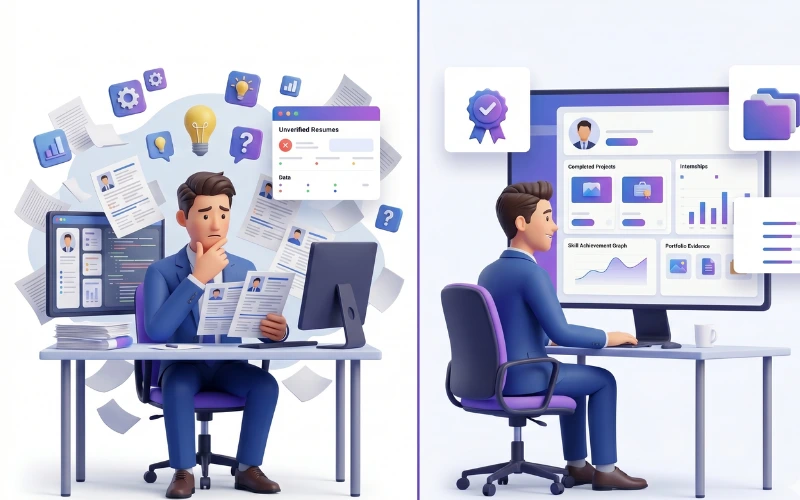
Picture a different version of the same drive.
A recruiter arrives at your campus. Before the interviews begin, they can see each candidate’s verified skill profile. Not a resume. A documented record of every course completed, every project built, every certification earned across the entire degree programme. All verified. All timestamped. All independently trustworthy.
The conversation in that interview room is completely different.
The skepticism drops because the proof is already there. The recruiter is not trying to uncover whether a candidate has the skills. They are exploring how those skills apply to the role. Offers get made faster. The quality of the match improves. And when those hires work out, the recruiter does not need to be chased for next season.
They come back on their own.
That is the shift. And it does not happen because the placement cell worked harder at relationship management. It happens because the students arrived with something the recruiter could trust.
How Campus Placement Builds Employer Partnerships That Last
The placement cells that have companies requesting slots months in advance built something most are still missing.
They changed when employer relationships begin.
Instead of inviting companies at the end of the academic year for drives, they brought employers into the program itself. Companies shared what skills they were hiring for. The institution built pathways around those requirements together with those employers. Students spent their degree years developing exactly the capabilities specific companies needed.
By the time a student reached their final year, they were not a stranger to the recruiter. They were a candidate shaped around that company’s actual requirements, with a verified record to prove it. That changes everything about how a placement drive feels to a recruiter.
They are not evaluating unknowns. They are meeting candidates they helped prepare. The trust is already there before the first interview begins. Over time, that trust compounds. Companies start sharing what they plan to hire for next year. Placement cells use that information to guide the next batch of students. The pipeline builds itself, not through effort but through evidence.
What Placement Cells With Better Results Are Doing Differently
The placement cells consistently outperforming their peers are not the ones with bigger budgets or more industry contacts. They are the ones who changed what they document, when they start, and how they present students.
They stopped waiting for placement season to start preparing students. Institutions with strong recruiter return began building student readiness from semester one. Skill development, practical projects, and verified certifications happen throughout the degree, not crammed into the final months.
They started issuing skill transcripts alongside degree transcripts. Not a grade sheet but a verified record of every project, internship, workshop, and certification completed during the program. When a recruiter receives something they can independently verify, the placement table conversation changes immediately.
They brought employer partners into the program early. The strongest placement cells have companies involved in the academic journey from the beginning. Employers help define what skills they need. The institution and those employers build pathways together. By final year, students are already shaped around what specific companies are actively hiring for.
They track which students are ready well before drives begin. Finding out that half a batch is not shortlist-ready when a company has already arrived is the most avoidable problem in campus placement. Structured readiness tracking identifies gaps months in advance, when there is still time to close them.
One Question Worth Asking Before Next Placement Season
If a recruiter who visited your campus last year called you today and asked why they should return, what would you tell them?
Not what you hope will be different. What you can actually show them is different. Most placement cells cannot answer that question with hard evidence. Because the systems to build, document, and present that evidence in a way recruiters trust have not been put in place. The institutions that can answer it clearly are the ones companies keep coming back to.
Where SOLO Network Fits In
Since this is the SOLO blog, it would be dishonest not to say that upfront. But here is why it is directly relevant to everything above.
SOLO gives institutions a white-labeled platform they run under their own name. Your placement cell can add students to the platform from day one of their program. As students complete courses, projects, internships, workshops, and certifications, every achievement gets documented and verified inside SOLO automatically.
By the time a recruiter arrives for a drive, each student already has a verified professional record built across their entire academic journey. Not a resume. A living, verifiable profile that a recruiter can trust before the interview even begins.
The pathways inside SOLO are not designed by SOLO. Your institution and your employer partners build them together based on what those companies are actually hiring for. SOLO provides the infrastructure and the verification layer. The relationships and the academic direction stay entirely with you.
When employers see that your students arrive at drives with verified, documented skills aligned to their specific requirements, they stop treating your campus as one of many options. They start treating it as a reliable pipeline worth investing in.
And because SOLO lets your placement cell track graduate employment outcomes over time, you always have the data to go back to employers with something valuable. How the last batch performed. What the next batch looks like. The kind of information that turns a seasonal visit into a long-term partnership. If the companies you want are visiting once and not returning, this is genuinely worth exploring.
Get in touch with the SOLO team and see how it works for your institution.
Frequently Asked Questions
Why do recruiters stop returning to campus after placement drives?
Recruiters stop returning when drives consistently disappoint them. The most common reason is candidates who cannot demonstrate verified skills. When a recruiter cannot trust what they see on a resume and the hire does not work out, they quietly redirect their time to campuses that deliver more reliable results.
How can placement cells build structured hiring pipelines with employers?
Structured pipelines are built by involving employers in the academic journey early, not just at placement time. When companies help shape skill pathways during the program, they develop a stake in the outcome and return consistently to hire students they helped prepare.
What is the difference between a resume and a verified skill profile?
A resume is self-reported and unverifiable. A verified skill profile is a documented record of everything a student learned, built, and achieved throughout their academic program, independently verified and trustworthy to any recruiter who views it.
How does skill verification improve employer relationships in campus placement?
When students arrive at placement drives with verified skill records, recruiters can evaluate candidates with confidence rather than skepticism. Better hires lead to better outcomes. Better outcomes bring recruiters back. Over time that consistency builds the trust that turns transactional visits into structured hiring pipelines.
What should placement cells do differently to improve campus placement outcomes?
Start building student readiness from semester one instead of the final months. Issue verified skill transcripts alongside degree transcripts. Bring employer partners into the curriculum early to build skill pathways together. Track student readiness continuously so gaps are identified and addressed before drives begin.